A customer-led workflow

Market Intelligence

Build a living market intelligence system from the conversations you're already having — automatically detecting competitive mentions, buyer trends, and emerging opportunities without a dedicated research team.

Customer evidence

Rappi
Citations in reports are critical for us. They build trust and prove accuracy — when leadership sees top citations, it reinforces credibility.
Juan CanalHead of Product, RappiRead their story

Make the decision with the evidence in reach.

Ask a specific question of your company context. Inspect the accounts and source material behind the answer before using it in a report or a team decision.

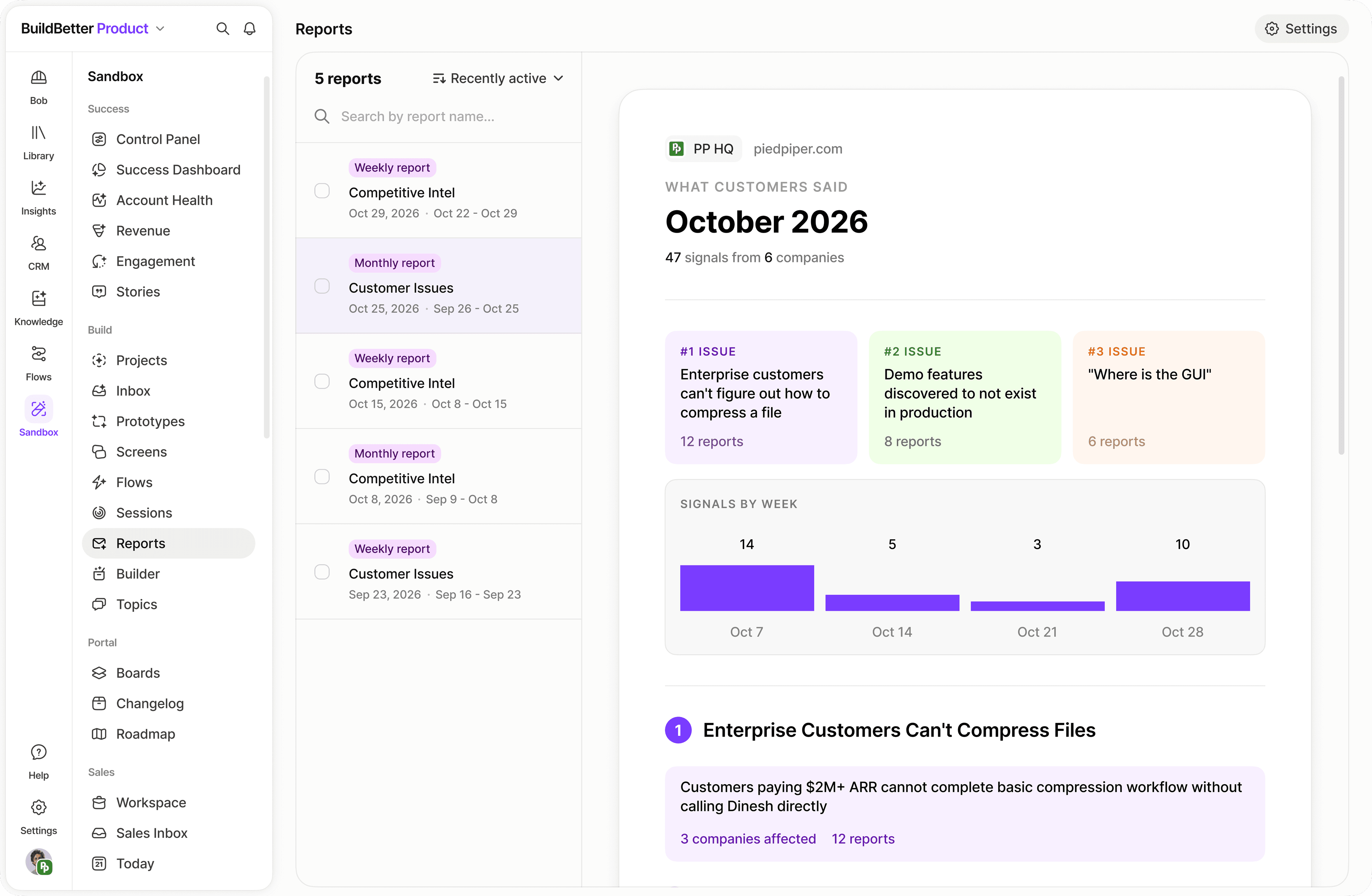
BuildBetter interface supporting Market Intelligence
Product example. Inspect findings alongside their customer and source context.

Put it to work.

01

Competitive Mention Tracking

BuildBetter automatically flags every competitor mention across your call library. See which alternatives prospects considered, how they describe each competitor, and how often specific tools come up in deals you win versus lose.

02

Win/Loss Intelligence from Actual Conversations

Instead of relying on post-hoc CRM fields, pull the real reasons from transcript signals. Surface the objections that ended in losses, the proof points that closed wins, and the switching triggers that brought prospects to you in the first place.

03

Emerging Trend Detection

Run a monthly query to identify pain points or topics that are appearing more frequently than in previous periods. Market shifts show up in conversation data weeks before they appear in industry reports.

04

Buyer Psychology Mapping

Understand not just what buyers decide but how they decide: who's involved, what they prioritise, what triggers urgency, and what stalls deals. This informs both positioning and sales enablement simultaneously.

05

Natural Segment Discovery

Find clusters of customers who describe similar problems in similar ways — these emergent segments often reveal ICP refinements and positioning opportunities that top-down demographic segmentation misses.

06

Opportunity and Whitespace Mapping

Surface unmet needs that customers articulate but that no current solution addresses well. These are your product roadmap and positioning opportunities — problems visible in your calls before they appear in your competitors' feature sets.

A practical place to start.

Set up competitive intelligence tracking
  1. Query all competitor mentions in your call library

    Ask Chat: 'Which competitor tools or alternatives do prospects mention most often in sales calls? How do they describe each one?' Get a ranked list with representative quotes.

  2. Segment by win/loss outcome

    Cross-reference competitive mentions with deal outcome tags. Which competitors appear most in lost deals? Which come up and then disappear by the close? The pattern tells you where to compete and where to retreat.

  3. Build a competitive intelligence brief

    Ask Chat: 'Summarise what prospects say about [competitor] in our calls. What do they like? What frustrates them? Why did they evaluate us instead?' Use this to update battle cards monthly.

  4. Track pricing position signals

    Filter Signals for mentions of price, cost, or budget. Map how pricing objections correlate with specific competitors and segments — your real pricing position lives in these conversations, not in your spreadsheet.

Detect market trends in real time
  1. Run a monthly trend query

    Ask Chat: 'What pain points or topics are appearing more frequently in calls this month compared to last month?' Rising themes are your leading indicators of market shifts.

  2. Track technology and regulatory mentions

    Filter Signals for mentions of specific tools, platforms, regulations, or industry events. These signals reveal how your buyers' broader context is changing — which informs both messaging and product direction.

  3. Identify urgency triggers

    Look for patterns in what events push prospects from 'interested' to 'buying now': a new hire, a failed audit, a funding round, a competitor winning a major account. These triggers shape your demand generation strategy.

Map buyer psychology and decision-making
  1. Surface the decision committee

    Ask Chat: 'Who else do prospects mention as part of their buying decision? What concerns do each stakeholder type raise?' Map the real decision-making structure across your ICP, not the one on the org chart.

  2. Identify what stalls deals

    Filter for stall signals — Objection type with specific themes like 'need to check with IT', 'waiting on budget', 'comparing options'. Each stall pattern has a corresponding enablement or marketing asset that could unstick it.

  3. Understand the 'before state' in detail

    Query: 'How do prospects describe what they were using or doing before looking at us?' This tells you both your competitive landscape and the alternative that matters most — often the status quo, not a direct competitor.

Synthesise and distribute intelligence
  1. Produce a monthly market intelligence brief

    Ask Chat: 'Summarise the key competitive and market trends from this month's calls. What's new? What's shifting? What should the team know?' Distribute to sales, product, and leadership.

  2. Update battle cards from real conversation data

    Replace assumption-based competitive positioning with quotes and patterns from actual calls. Battle cards grounded in buyer language are more trusted by sales reps and more effective in deals.

  3. Feed strategic planning with conversation-based evidence

    Before quarterly planning, run a comprehensive market intelligence query. Present real evidence of where the market is going — not analyst speculation — to anchor strategy discussions in data.

Keep the workflow useful
  • Run your competitive intelligence query monthly at minimum — markets shift faster than quarterly review cycles can track
  • Always segment competitive mentions by deal outcome (won/lost/open) — a competitor mentioned in lost deals is very different from one mentioned and then discarded
  • Share intelligence briefs with product as well as sales — the unmet needs you surface in calls are your most valuable roadmap inputs
  • Build a 'market signals' document that logs trending pain points and competitive mentions quarter-by-quarter so you can see shifts over time
  • Use conversation-based intelligence to anchor quarterly planning discussions — hard evidence from buyer conversations carries more weight than intuitions or analyst frameworks
  • Track what prospects say about you, not just competitors — 'How do buyers describe the problem we solve?' is your most important positioning question

Keep exploring.

Ready to build a market intelligence system from conversations you're already having?

Bring a real question. We’ll walk through the context and the next step together.

Book a demo