

01
Intelligent Capture
Automatically detect and consolidate requests from every source—sales calls, support tickets, customer success notes, and product analytics.

A customer-led workflow
Turn feature request chaos into strategic product decisions with AI that captures, analyzes, and prioritizes what customers truly need
Customer evidence

“BuildBetter is becoming our go-to tool for strategic planning.”
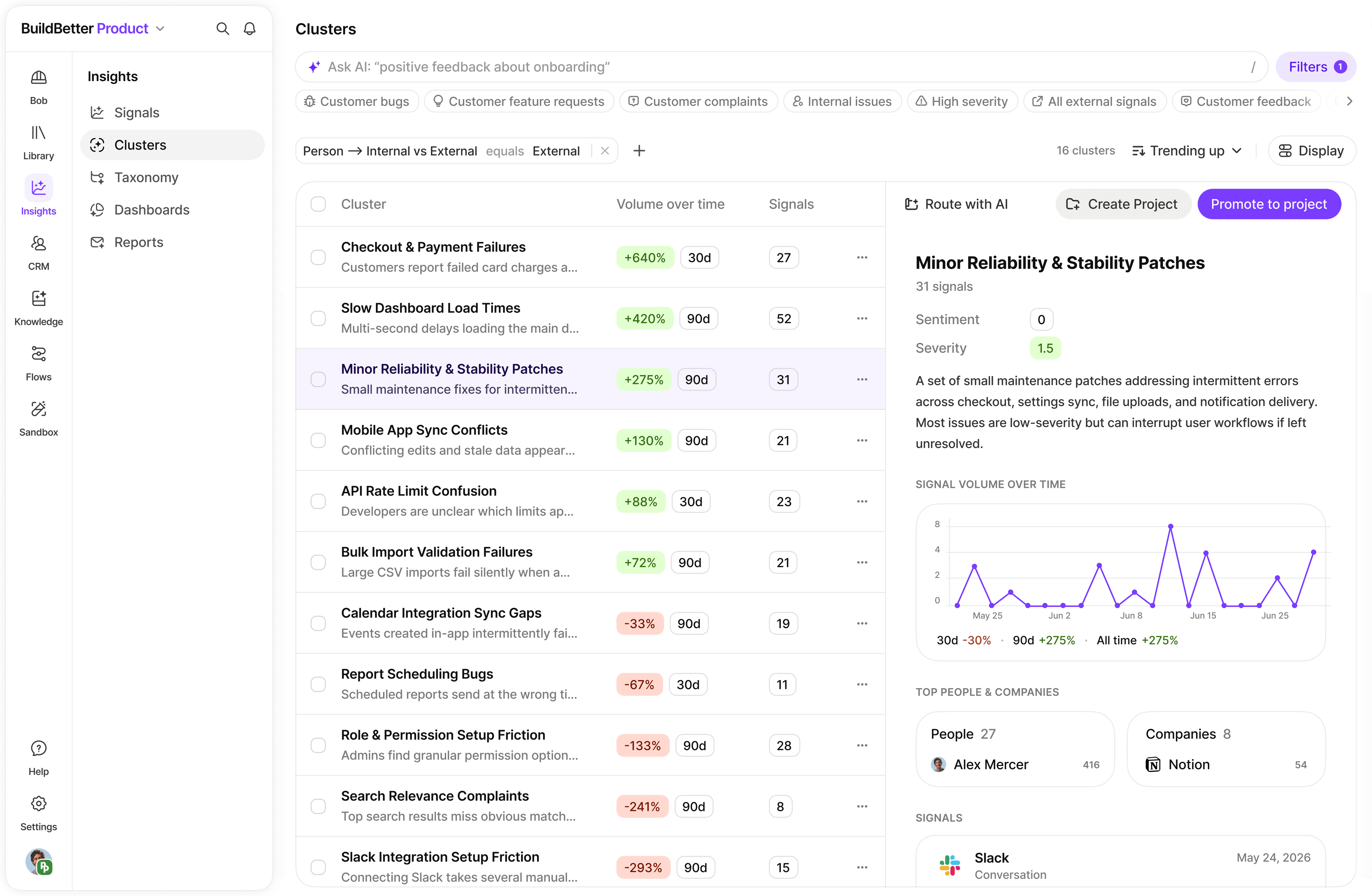
Bring customer feedback together, inspect the source, and carry the evidence into the decision. The example interface below shows how your team can work with that context.
01
Automatically detect and consolidate requests from every source—sales calls, support tickets, customer success notes, and product analytics.
02
Quantify revenue, retention, and strategic value of each request so you can rank by real business impact instead of who spoke loudest.
03
AI identifies similar requests you'd never connect manually using semantic matching, cross-channel correlation, and use-case similarity.
04
Know exactly who wants what and keep every requester informed automatically as requests move through your pipeline.
Connect all request sources (sales calls, support tickets, customer success, analytics) and import the last 12 months of historical data to establish a single source of truth.
Configure a revenue scoring model weighting direct revenue impact (40%), customer impact (30%), strategic value (20%), and effort (10%). Add high-value signal keywords like 'deal breaker' and 'switching to competitor'.
Automate request processing: extract details, check for duplicates, calculate impact score, identify stakeholders, categorize, and send acknowledgment to the requester.
Use cluster analysis to discover hidden themes, track how requests evolve over time, find unexpected correlations between requests, and surface competitive intelligence.
Model expected revenue from each feature before building—include new sales impact, expansion revenue, retention uplift, and development cost to calculate payback period.
Map influence networks, segment requesters by engagement level, manage beta programs, and link delivered requests back to measured outcomes.
Connect request scores directly to product strategy, run trade-off analyses (build vs. buy vs. partner), and track realized ROI against predictions after launch.
Identify design partners from your highest-impact requesters, run rapid prototype validation, and manage alpha/beta cohorts with structured feedback loops.
Analyze which features drive competitive losses, find win-back opportunities among churned customers, and build differentiation roadmaps from competitive request patterns.
Bring a real question. We’ll walk through the context and the next step together.
Book a demo